
Topline, Self-Carriage, Collection... and Gadgets: What They Really Are - and What They’re Not


Using gadgets to "create" topline, self-carriage or collection is like getting butt implants to improve your squat.
In the world of horse training, few concepts are as misunderstood or as misused as "self-carriage" and "collection". They're often treated like aesthetic goals: a certain "look", a frame, a head position. But true self-carriage and collection aren't about appearances. They're about biomechanics, balance, and the horse's ability to move with integrity, strength, and autonomy. They are natural, not manufactured, not held in place by some gadget.
What's a dead giveaway that someone doesn’t understand equine biomechanics? They try to strap it on. I used to be one of those people. I used to lunge in draw reins. Why? Because I thought they would help the horses I worked with go "on the bit" and work in a nice frame, and develop all the right muscles. Unfortunately, that's not how things work. At that time, I didn't know any better, and various more experienced horse people encouraged me to use them. Here's what I learnt:
What Is Self-Carriage?
Self-carriage is the horse maintaining its own rhythm, balance, and posture without constant input from the rider; without some gadget holding it in place. It's the ability to move forward, turn, transition, and halt without being held together by the reins or legs. A horse in self-carriage is mentally engaged, physically balanced, and emotionally regulated. It's not being micromanaged; it’s being trusted.
What Is Collection?
Collection is a gymnastic state where the horse shifts more weight onto its hindquarters, shortens its frame, and lifts through the withers and back. It's not about tucking the nose or arching the neck - it's about engagement, strength, and balance. True collection emerges from correct training, not coercion or being held in place. It's a product of physical development and mental readiness, not mechanical manipulation.
The Gadget Trap
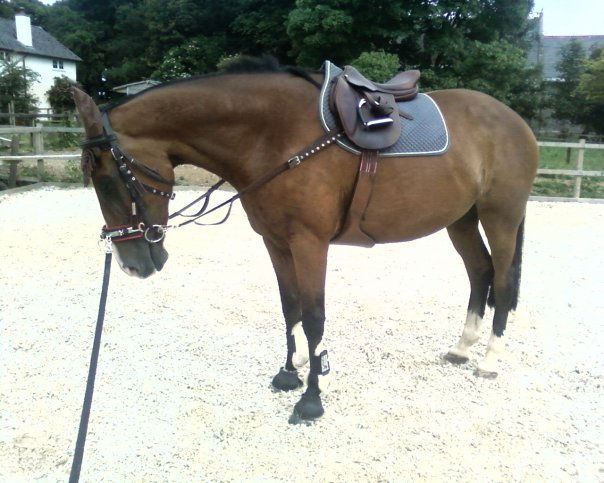
Let's be blunt: using gadgets to "create" self-carriage or collection is like getting butt implants to improve your squat. Sure, it might look like you've got the glutes of a powerlifter, but when it's time to drop into a deep, stable squat, those implants aren't going to help you generate force, balance, or coordination. They're cosmetic, not functional.
The same goes for training aids like the Pessoa, neck stretchers, draw reins, etc. They might shape a horse's outline, but they definitely don't build the neuromuscular strength, proprioception, or emotional readiness required for true collection. In fact, they often interfere with the horse's natural movement patterns and responsiveness, suppressing the very systems we're trying to develop.

And now, science is catching up to what many ethical trainers have long advocated for. A 2025 study by Mikaela Tapuska at the University of Edinburgh, presented at the International Society for Equitation Science (ISES), surveyed 570 riders to understand why they use gadgets like side reins and draw reins. The results were sobering:
Over 80% of riders couldn't identify a balanced trot from diagram sequences.
Riders who used gadgets were significantly less likely to understand equine biomechanics.
Most began using them due to social influence or perceived lack of skill - not evidence-based reasoning.
Continued use was driven by habit and convenience, not effectiveness.
In Tapuska's words, "The perceived benefits of using auxiliary reins had become part of the solution to their riding-related challenges." Translation? Gadgets are often a crutch for riders who haven't been taught - or haven't taken the time - to build the horse’s balance from the inside out.
The Marketing Mirage
These gadgets weren't born from biomechanics or behavioural science - they were born from marketing. From the desire to sell a supposed shortcut. To give all the people who didn't know how to achieve self-carriage and collection a "solution" that could make even the shoddiest horse person look like they could do what the best could. But horses aren't machines. You can't bolt on balance or strap on engagement. You have to build it from the inside out. You have to teach a horse to think "lift". And that takes knowledge, skill, and time. Not gadgets. Sorry.
The Pessoa system, for example, was developed by showjumper Nelson Pessoa to "help horses build muscle and balance during lunging". While it can offer short-term superficial postural changes, research shows it doesn't reliably activate core musculature or improve spinal stability.
Neck stretchers and similar aids often rely on pressure-and-release mechanics that suppress natural movement, mask discomfort, and teach horses to brace rather than balance. They don't teach "lift". And, because they're all "dumb" tools that can't think for themselves or adjust, they cause downregulation of receptor activity, i.e. they make your horse dull to your aids because the gadgets just go "pull-pull-pull" with no let up. A bit like if Pavlov rang the bell but didn't give the dogs any food; the dogs would learn that the bell didn't mean anything and start to ignore it.
The Pessoa, the neck stretcher, the draw reins... you name it, they've all been marketed as tools to "build topline", "encourage engagement", or "create collection". But these devices do none of these things. In fact, use can lead to tension, hollowing, and even pain responses - particularly when horses are forced into frames they're not physically ready to maintain.
What Actually Works
If you want to build topline or develop your horse's self-carriage and collection, skip the gadgets. Choose the horse. Choose the process. Understand what self-carriage and collection actually look like, and how topline is actually developed.
To put it simply, we need to develop the abs, the glutes, the loins, and the spinal muscles of the horse. We do this by doing exercises which encourage the horse to lift its front end and to step further under its body with its hind legs. Here's what actually builds strength, balance, and engagement:
Turnout over varied terrain: Navigating hills, uneven ground, and natural obstacles develops proprioception, joint stability, and muscular coordination.
Hill work and pole work: These exercises activate the hindquarters, stretch the topline, and improve stride regulation.
Turns on the hindquarters, rollbacks, and rollovers: These movements build agility, balance, and mental responsiveness. They teach the horse to shift weight, engage the core, and coordinate movement from back to front.
Transitions and lateral work: Done thoughtfully, these build strength and teach the horse to carry itself through changing demands.
Rest and recovery: Because no horse can collect if they're sore, stressed, or depleted.
The Science of Simplicity
Equine behavioural science and biomechanics agree: horses learn best through clear signals, consistent reinforcement, and freedom of movement. When we stop interfering - stop holding, forcing, and framing - we allow the horse to discover balance on their own. That's where true collection lives. Not in the gadget. Not in the outline. In the process.
The Ethical Invitation
Let's stop chasing the look. Let's stop buying the shortcut (to where?). Let's start asking: Is this helping my horse develop strength, confidence, and autonomy? Or am I just holding them together?
Because self-carriage isn't something we impose. It's called self-carriage, after all - not rider-assisted-carriage or gadget-imposed-carriage. It's something we invite. And collection isn't something we create. It's something the horse offers - when they're ready.
If you'd like help setting up a programme that really builds your horse's topline and develops self-carriage and collection, give me a shout.
Love and light,
Vicci
Follow us on Facebook: https://www.facebook.com/zenhorseandhuman
Follow us on Instagram: https://www.instagram.com/zenhorseandhuman/


Comments